
Trucks & Commercial Vehicles
New York City's economic vitality and livability as a world-class city depend on a robust logistics and supply chain network that serves our 8.5 million residents, supports over 4 million jobs, and welcomes 62 million tourists annually. Trucks and commercial vehicles are essential to New York City, providing goods and services to millions of New Yorkers every day.
Freight Mobility
NYC DOT is committed to advancing transformative policies and programs to enhance the safety, efficiency, and sustainability of goods movement, mitigating the adverse effects of truck traffic on infrastructure and communities. We integrate these objectives to preserve the city's livability and simultaneously bolster New York City's economic competitiveness and vitality. We provide resources such as maps and FAQ for truck drivers, programs for freight transporters, and implement improvements for making deliveries more sustainable in New York City.
Contact us online via our webform
Subscribe to our Freight Mobility newsletter
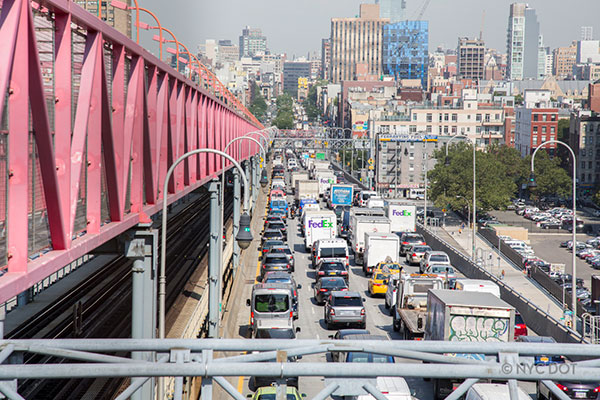
The City's unique blend of land uses, dense urban environment, and extensive transportation infrastructure necessitate a distinct set of rules and regulations for truck and commercial vehicle operations. For this system to function efficiently, drivers need to adhere to these rules and regulations.
Resources: Truck Map & Routes NYC Traffic Rules & Regulations Safety Tips for Drivers Parking and Making Deliveries Express Lane Permits Freight Programs & Initiatives Reports & Studies Truck Driver FAQ
Truck or Commercial Vehicle?
New York City has unique definitions for commercial vehicles and trucks that differ from New York State Department of Motor Vehicles classifications. Find out how your vehicle is classified so you know what rules and regulations apply to you.
Safety Tips for Drivers of Trucks and Other Large Vehicles
Operating a truck or large vehicle in NYC can be difficult and poses some of the greatest risk.
To make our streets safer for everyone, truck and commercial vehicle drivers must do their part by learning safe practices.
Truck Smart Guide
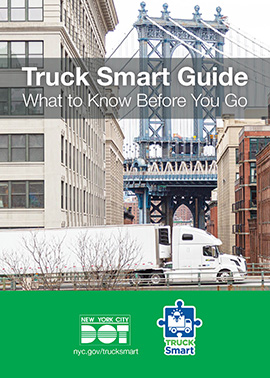
Truck Smart Guide – What You Need To Know Before You Go is the official guide to safe truck driving in New York City. This helpful handbook is filled with tips and information to keep everyone travelling throughout NYC safer and smarter.
Truck Smart Guide – What You Need to Know Before You Go Guía Truck Smart: Qué debe saber antes de partir Truck Smart 指南 – 出發前須知 Руководство Truck Smart – Что нужно знать перед поездкой Request paper copies of the Truck Smart Guide
Things to Know Before You Go:
- Always do your pre-trip safety inspections
- Plan your route
- Slow down and give pedestrians and cyclists space
- Signal for safety
- Remember - Backing up at an intersection or crosswalk is illegal and dangerous
- Avoid distractions
- Do not use cell phone mounts or other items that obstruct your view
- Get enough rest - don’t drive when you’re tired
Watch NYC's "I See You: Safety for Trucks & Other Large Fleet" video for safety tips for truck and large fleet drivers:
Truck Routes

With nearly 1,000 miles of designated roadway, New York City has one of the most complex truck route systems in the nation. Need help navigating the city by truck? Learn more about different types of truck routes
Parkway Restrictions
Trucks and commercial vehicles cannot travel on most parkways in New York City.
Read a complete list of parkways where trucks and commercial vehicles are prohibited Commercial Vehicles, Trucks & Tractor Trailers are Not Allowed on New York State Parkways Brochure (pdf) Request paper copies of the parkways brochure
Truck Route Geodata
The New York City Truck Routes map data is available in shapefile on NYC Open Data. These data sets contain the centerlines of through and local truck routes, and were created from LION, the City's base map of streets.
Truck Route Layer on NYC Open Data (shapefile) Truck Route Layer on NYC Open Data (map)
New York City Truck Route Map
This map is to be used for reference purposes only. Please refer to the New York City Traffic Rules for the most current traffic regulations governing truck routes as well as permissible truck weight and dimensions. Information on this map is subject to change without notices. Always observe all posted restrictions as limitations may apply to designated truck routes.
NYC DOT publishes a full-color, double-sided map featuring the City's comprehensive Truck Route network overlaid on top of the entire arterial street network, making it easier for drivers to locate specific streets and intersections. The map also contains helpful information on truck route signage, weight limits and dimensions, overweight/overdimensional permitting and truck related violations as well as City, regional and state truck-related resources.
As part of the Delivering New York: A Smart Truck Management Plan, we continue work to improve our truck route network and map. Check our website and sign up for the Freight Newsletter to stay informed of the latest freight policy and updates.
See a mistake? Please help us make the next edition of this map more accurate. Inform NYC DOT about any inaccuracies or omissions you may notice via our webform.
2022 New York City Truck Route Map (pdf) Request paper copies of the 2022 Truck Route Map
Truck Route Network Redesign
As required by Local Law 171 of 2023, NYC DOT is working to keep up with changes in residential and commercial land use patterns, the transportation network, reduce network redundancies, and adapt to changing delivery patterns. We encourage all stakeholders to stay up to date by visiting our Truck Route Network Redesign Portal.
Past Truck Route Changes
There have been truck route changes since 2015 to the Truck Route Map. For details of changes, see links below. Details on truck route changes in Staten Island (pdf)
Changes made to the Truck Route network and map between 2012 and 2015 are summarized below. For details of changes, see links below. Details on truck route changes in Brooklyn (pdf) Details on truck route changes in Queens (pdf) 53 Foot Tractor Trailers can access specific and limited routes to JFK Airport in Queens. See the reverse side of the 2022 Truck Route Map for more information.
Express Lane Permits
NYC DOT issues Express Lane Permits that enable ambulettes, commuter vans and shuttles and other mass transit fleets to use the high occupancy vehicle (HOV) lanes leading to the Queens-Midtown and Brooklyn-Battery Tunnels.
Rules and Regulations
The New York City Traffic Rules and Regulations are contained in Chapter 4 of Title 34 of the Rules of the City of New York. It includes rules on traffic signals; pedestrians; restrictions on turns; speed restrictions; other restrictions on movement; rules for parking, stopping, and standing; rules for buses, taxis and for-hire vehicles; truck routes; rules pertaining to parkways and parks; limitations on dimensions and weight of vehicles; and other information.
Loading Zones
Loading Zones provide space at the curb for loading and unloading passengers and goods. Types and Map of Loading Zones
Commercial Vehicle Identification
The New York City Traffic Rules require that commercial vehicles display the registrant's name and address on both sides of the vehicle. This is described in Section 4.08 of the Traffic Rules.
The Federal Motor Carrier Safety Administration (FMCSA) issues vehicle identification numbers, known as USDOT numbers, to commercial vehicles that operate interstate to transport passengers, or haul cargo. New York State requires intrastate commercial motor vehicle registrants to obtain a USDOT number. For more information, contact the FMCSA at 800-832-5660 or visit https://www.fmcsa.dot.gov/registration/do-i-need-usdot-number.
Highway Use Tax (HUT) numbers are administered by the New York State Department of Tax and Finance. For information call 1-800-980-5437 or (in New York State) 518-388-5245, or visit OSCAR.
Weight and Size Limits
The allowed gross vehicle weight in New York City is 80,000 pounds. Read the full weight and size limits Vehicles that exceed New York City's size and weight limits must obtain overdimensional permits.
Parking a Truck or Commercial Vehicle
What you need to know about parking your truck or commercial vehicle in New York City.
Freight Programs & Initiatives
Deliveries in New York City
NYC DOT is exploring alternatives to move goods through our city more sustainably and efficiently.
NYC Clean Trucks
The NYC Clean Trucks Program provides rebate incentives and a network of resources to local commercial fleet operators so that they may transition away from diesel and towards clean, advanced trucks and transportation technologies. NYC Clean Trucks Program Website
Transport Refrigeration Unit (TRU) Incentive Program
NYC DOT provides Transport Refrigeration Unit (TRU) incentive funding toward the purchase of Tier 4 Final or ultra-low-emissions TRUs to qualified applicants in Hunts Point. Qualified fleets will work with the City to promote the reduction of harmful emissions from Tier 0, Tier 1 and Tier 2 TRU engines.
Truck Safety & Education
Cross Over Mirrors
Because of the height of large trucks, it can be difficult for truck drivers to see what is happening directly in front of their vehicles. This has contributed to a significant number of pedestrian deaths in New York City.
Cross over mirrors must be installed on all trucks that
- Qualify as Commercial Vehicles,
- Are registered in New York State, and
- Operate in New York City (except for expressways).
Installing cross over mirrors in front of the cab of a truck is a simple way of eliminating a truck driver’s front “blind spot” and allowing the driver to see any person at least three feet tall and passing one foot in front of the vehicle. School buses have long been required to have cross over mirrors. The mirrors are relatively inexpensive and manufacturers typically offer them below list price, and provide bulk discounts.
Cross Over Mirrors Law Cross Over Mirrors for Trucks (pdf)
Reducing Emissions from Non-Road Equipment (Local Law 77)
Local Law 77, which was signed into law in 2003, requires the use of ultra-low sulfur diesel and "best available technology" for reducing emissions from non-road equipment used on City construction projects.
Verified Technologies List of all the diesel retrofit technologies that the US Environmental Protection Agency has approved for use in engine retrofit programs Summary of verified diesel emission control strategies by the California Air Resources Board
Truck's Eye View
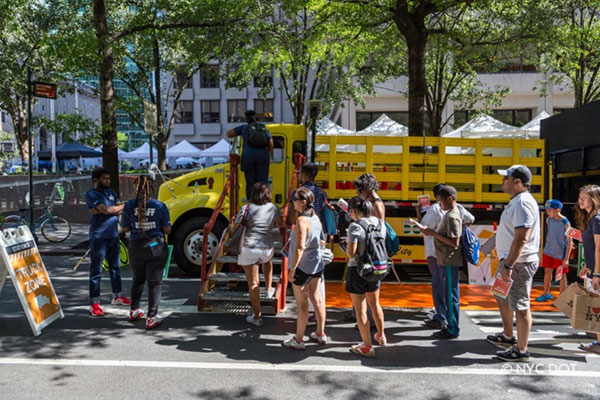
NYC DOT developed the Truck’s Eye View program in 2011 to provide education to the public on the obstructed vision areas around large trucks. At events citywide, participants can sit in the driver’s seat of a truck and learn about the vehicle’s obstructed vision areas from a professional truck driver, to increase safety awareness for all roadway users.
To learn more about the Truck’s Eye View Program or request a display at a community event in your area, please contact us via our webform.
Check It or Wreck It
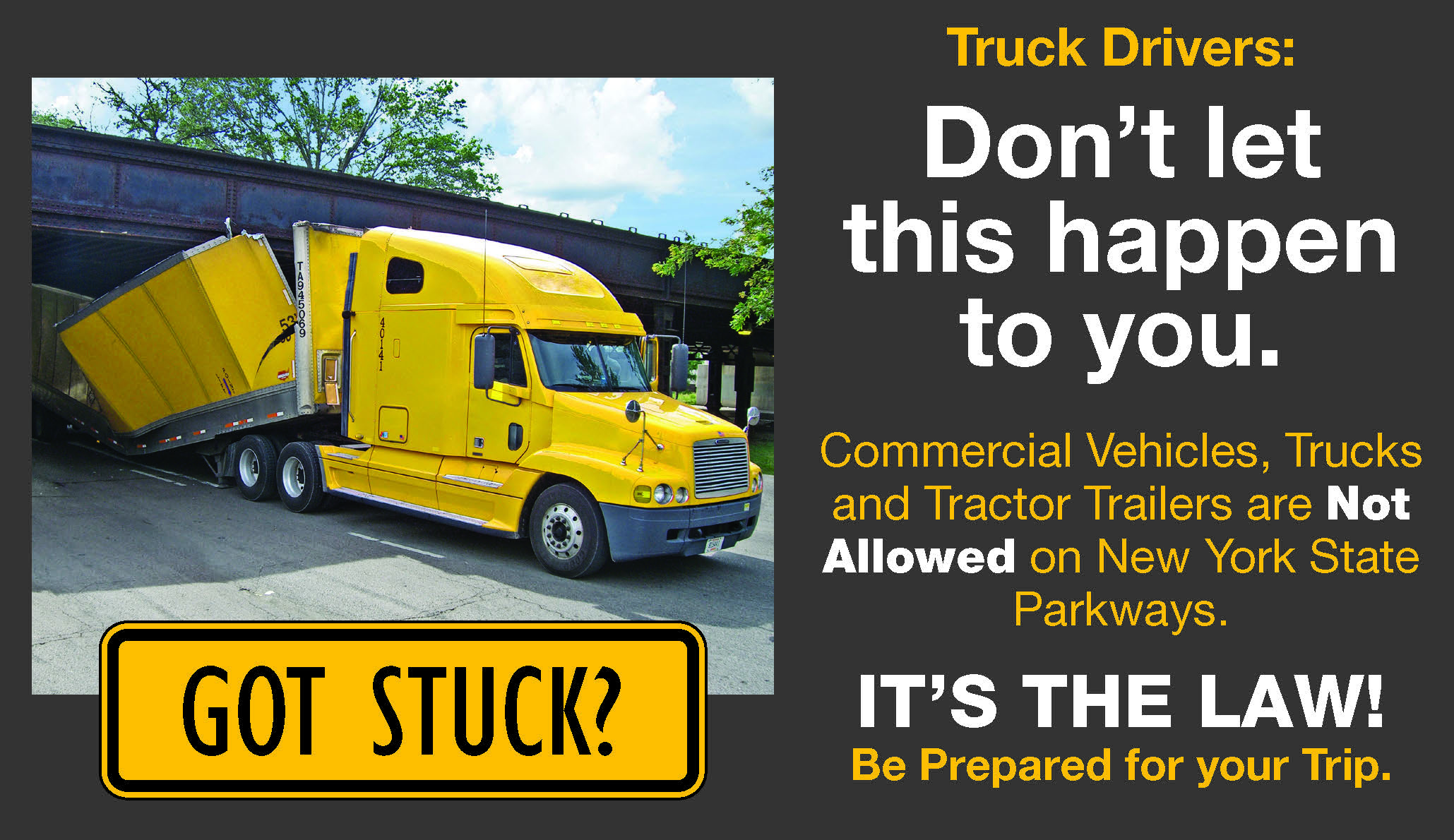
NYC DOT’s Check It or Wreck It campaign encourages truckers to view the truck route map, use a truck-specific GPS and avoid parkways in the New York Metro Area.
Reports & Studies
Delivering New York & Delivering Green
Delivering New York: A Smart Truck Management Plan for New York City and Delivering Green: A vision for a sustainable freight network serving New York City highlight the critical work needed to execute New York City’s shared vision for safer, more efficient, and sustainable freight movement. Together, these initiatives represent a comprehensive effort by New York City to reimagine its freight system. By doing so, New York City aims not only to enhance the quality of life for its residents but also to set a benchmark for urban freight systems worldwide.
Improving the Efficiency of Truck Deliveries in NYC
Understanding the challenges of urban freight deliveries in NYC today enables us to identify opportunities for improved efficiency in the last mile delivery. Read the 2019 report: Improving the Efficiency of Truck Deliveries in NYC 2019 Report
Newsletter
Subscribe to the NYC DOT Freight Newsletter:
Newsletter Archive:
November 2023August 2023 (reminder)August 2023June 2023April 2023February 2023January 2023